
Jamaica Kincaid, an Antiguan-American novelist and Harvard professor, has cultivated a literary style that grafts her personal experiences with broader themes of colonialism and identity.
Born Elaine Potter Richardson in Antigua in 1949 during British rule, Kincaid’s colonized education forced her to memorize facts about a culture that didn’t belong to the island. Instead of learning about her own culture, she was forced to learn instead about places and things that she had never seen and that bore no relevance to her own life.
One experience that is particularly memorable to the author was when she was forced to memorize and recite the poem “I Wandered Lonely as a Cloud” by William Wordsworth. The poem is about daffodils, which Kincaid had never seen, as they were not native to Antigua.
The absurdity stuck with her, making her resent both the poet and the flower. In a 2022 interview, she recounted “We were asked to commemorate something that most of us would never see or would never really understand so I took a dislike to daffodils…As I became a gardener, I never grew daffodils. I hated them because of this experience or felt I hated them. And then one day…I thought what an injustice I myself was inflicting on Wordsworth and the daffodil because it wasn’t Wordsworth’s fault that I had been forced to learn the daffodils and he would have objected to my position as a colonized person. So in becoming a gardener, I started to plant daffodils. I call it redeeming Wordsworth. I recite the poem and drink cheap champagne every year when they’re in full bloom.”
Kincaid’s profound connection to gardening permeates her body of work, the author frequently drawing on her own experiences as inspiration for her fictional characters. In her novel “Lucy”, the protagonist grapples with themes of dislocation and cultural alienation, epitomized through her feelings towards daffodils – a symbol of her affluent employer Mariah’s privileged lifestyle. Like Kincaid, Lucy had been forced to memorize and recite the Wordsworth poem, a fact that fills the character with anger as she recounts the experience.
Kincaid’s latest book, “An Encyclopedia of Gardening for Colored Children”, continues to explore the themes of colonialism and gardening. The book, described by Celia McGee of the New York Times Book Review as “peeling back botany to display the history behind it — to reveal conquest as arrogant and destructive, economics as exploitation, the brutal privileges of slaveholding, the propagation of racial injustice,” pairs Kincaid’s blunt prose with whimsical illustrations from Kara Walker, renowned artist and MacArthur Fellow.
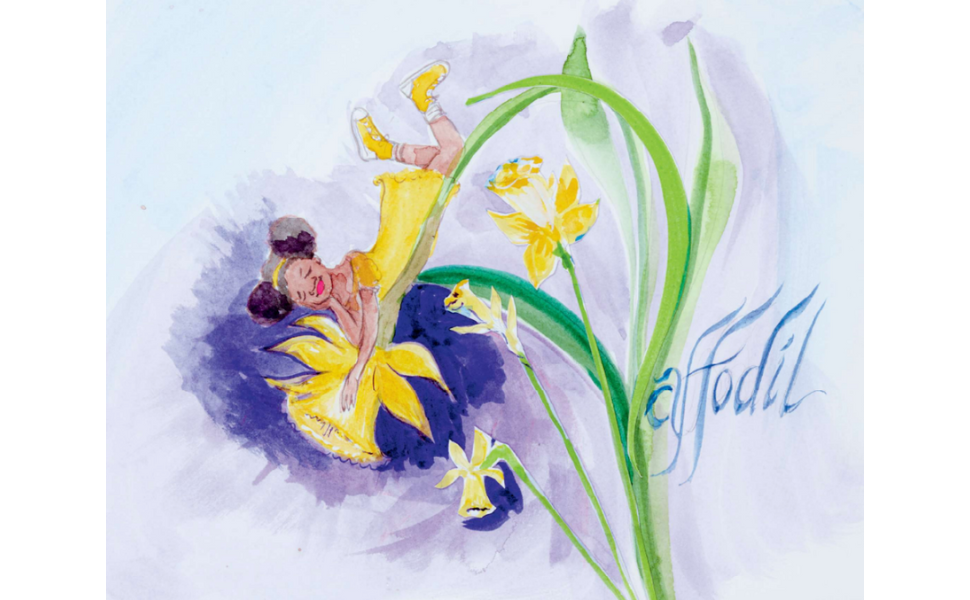
Excerpt from An Encyclopedia of Gardening for Colored Children:
“D IS FOR DAFFODIL, the common name for the Narcissus. It is native to the moist meadows and woods of temperate climates. Its appearance in the spring is eagerly awaited, its shy yellow color and slightly bowed blossom almost indicating gratitude for surviving the long dark days of the winter. The joy and abandonment of the burden that is everyday life a daffodil brings to an English person is commemorated in a poem by William Wordsworth, “I Wandered Lonely as a Cloud.’ This poem became canonical in the education of children who were subjects of the British Empire. For the most part, these children were native to places where a daffodil would be unable to grow and so would never be seen by them.”
In an essay for The New Yorker in 2020, Kincaid said “My obsession with the garden and the events that take place in it began before I was familiar with that entity called consciousness. This memory of growing things, anything, outside not inside, remained in my memory—or whatever we call that haunting, invisible wisp that is steadily part of our being—and wherever I lived in my young years, in New York City in particular, I planted: marigolds, portulaca, herbs for cooking, petunias, and other things that were familiar to me, all reminding me of my mother, the place I came from. Your home, the place you are from, is always Eden, the place where even imperfections were perfect, and everything that happened after that beginning interrupted your Paradise.”
Kincaid’s literary journey offers a compelling look at the enduring impact of colonialism on personal and collective identities. Through her writings, Kincaid invites readers to consider how historical injustices shape our cultural landscapes and personal narratives, and to acknowledge that “perhaps every good thing that stands before us comes at a great cost to someone else.”

 “Women are the real architects of society.”
Leave a comment