
*Content Warning: This article discusses themes of violence, sexual assault, systemic racism, and murder.*
May 5th is the National Day of Awareness for Missing and Murdered Indigenous Women and Girls (MMIWG), a solemn reminder of the disproportionate violence Indigenous women face in the U.S., Canada, and beyond. In honor of this day, here are nine powerful books that illuminate the crisis, center Indigenous voices, and call readers to action.
- Our Voice of Fire: A Memoir of a Warrior Rising by Brandi Morin
This memoir details the experiences of Cree/Iroquois/French journalist Brandi Morin, from her time in the Canadian foster system and as a runaway, to her fight as a voice for other Indigenous Women and Girls who did not survive and a light for the systemic issues still in place today.
“My work as a journalist unleashed a desire for justice in me–as strong as a wildfire–to help transform the narrative of Indigenous oppression.”
Brandi Morin
- Highway of Tears: A True Story of Racism, Indifference and the Pursuit of Justice for Missing and Murdered Indigenous Women and Girls by Jessica McDiarmid
Written by Canadian Journalist Jessica McDiarmid, Highway of Tears investigates the many Indigenous women and girls that have gone missing or been found murdered along a stretch of Highway 16 in British Columbia, Canada. Through interviews with the loved ones left behind, McDiarmid analyzes the part systemic racism has played and connects the cases with a broader pattern of indifference across the country.
“I am considered high risk just by virtue of being Indigenous and female. This is my reality.”
Mary Teegee Maaxsw Gibuu (White Wolf), From the foreword of Highway of Tears
- In My Own Moccasins: A Memoir of Resilience by Helen Knott
Helen Knott, a poet, activist, and social worker from the Prophet River First Nation, shares a raw and resilient memoir chronicling her journey through addiction, sexual violence, and intergenerational trauma.
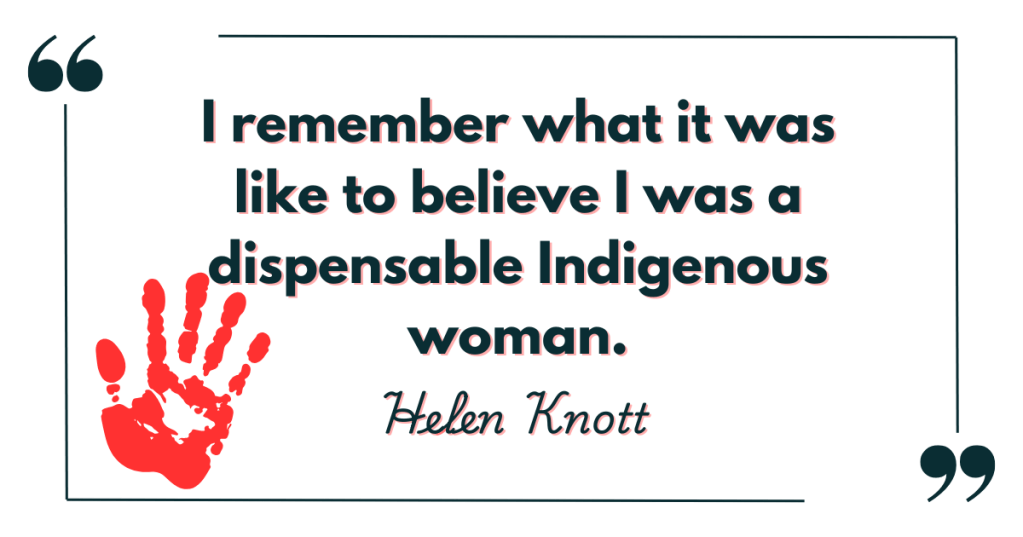
“I remember what it was like to believe I was a dispensable Indigenous woman.”
Helen Knott
- By the Fire We Carry by Rebecca Nagle
Rebecca Nagle is a journalist, activist, and citizen of the Cherokee Nation. On her podcast This Land, she tells the story of the small town murder that led to a landmark supreme court case over tribal land and her own family’s connection to it. By the Fire We Carry expands into the generations-long fight for justice and sovereignty in eastern Oklahoma and the impact of the Supreme Court ruling on tribal communities across the US.
Watch Rebecca Nagle discuss her book on Democracy Now!
“Embedded in American law are the victories and defeats of our ancestors, and the unimaginable compromises they were forced to make.”
Rebecca Nagle
- Five Little Indians by Michelle Good
Five Little Indians tells the story of five survivors of the Canadian Indian residential school system. The story is fictional, but is inspired by the real-life experiences of the author’s mother and grandmother within the system.
“Life was no longer just survival. It was about being someone. An Indian someone, with all the truth that was born into her at the moment she was placed in her mother’s womb.”
Michelle Good
- The Colonial Problem: An Indigenous Perspective on Crime and Injustice in Canada by Lisa Monchalin
Although this is a textbook, The Colonial Problem is a valuable resource in understanding the part systemic racism has played in the disproportionate crimes among Canada’s Indigenous peoples. The author is a criminology professor at Kwantlen Polytechnic University Surrey and the first Indigenous woman in Canada to hold a PhD in Criminology.
“The goal of educating students on Indigenous injustices is not to shame and blame but to join people from all backgrounds together as brothers and sisters on this healing and education journey.”
Lisa Monchalin
- Islands of Decolonial Love by Leanne Betasamosake Simpson
Simpson is a renowned Michi Saagiig Nishnaabeg scholar, educator, writer, and musician. This collection of short stories centers on the lives of Indigenous Peoples, especially the author’s own Nishnaabeg nation in Ontario, Canada, and provides a realistic depiction of struggles that are all-too familiar for these marginalized communities.
“The skillset you need to survive is not the same skillset you need to love and be loved.”
Leanne Betasamosake Simpson
- Red River Girl: The Life and Death of Tina Fontaine by Joanna Jolly
In 2014, the body of fifteen-year old First Nation member Tina Fontaine was found in Winnipeg’s Red River. Through Tina’s story, BBC reporter and documentary filmmaker Joanna Jolly explores how generational trauma and systemic racism affects Indigenous women and impedes their right to justice.
“Fierce, funny, protective, brave, risk-taking, she was a young woman trying to forge her identity and make difficult choices in what was often a dangerous world. It is a tragedy that Tina did not live to fulfill her potential, like hundreds of other Indigenous women who have met a similar fate.”
Joanna Jolly
- Stolen Sisters: The Story of Two Missing Girls, Their Families and How Canada has Failed Indigenous Women by Emmanuelle Walter
In 2008, Maisy Odjick and Shannon Alexander, two teenage girls from western Quebec, disappeared. Journalist Emmanuelle Walter spent two years investigating the case. Stolen Sisters tells not only their story but the story of the bigger crisis facing First Nations women as Canada continues to fail them.
Key Statistics – Canada:
- According to the Assembly of First Nations, the homicide rate for Indigenous women in Canada was 4x higher than that of non–Indigenous women from 2001 to 2014. Indigenous women are also more likely to experience physical and sexual assault.
- According to a 2013 study by the RCMP, Indigenous women accounted for 16% of all the homicides against females in Canada between 1980 and 2012 while only making up 4.3% of the population.
Key Statistics – United States:
- According to a 2016 study by the National Institute of Justice (NIJ), more than four in five American Indian and Alaska Native (AI/AN) women (84.3%) have experienced violence.
- According to the Bureau of Indian Affairs, there were 5,712 reports of missing American Indian and Alaska Native women and girls in 2016, however the National Missing and Unidentified Persons System only logged 116 of those cases.
- According to the National Indigenous Women’s Resource Center, Native women suffer from violence at a rate 2.5x greater than any other population in the US and face murder rates more than 10x the national average on some reservations.
Additional Resources:
- Native Women’s Association of Canada (NWAC)
- Native Women’s Wilderness
- Amnesty International Stolen Sisters Reports
- Reclaiming Power and Place: The Final Report of the National Inquiry into Missing and Murdered Indigenous Women and Girls
- Urban Indian Health Institute

 “Women are the real architects of society.”
Leave a comment